
Huawei in Madrid
The Galería de Cristal in the heart of Madrid is a luminous space, a glassed-in courtyard behind the city’s Palacio de Cibeles. Built in 1907, this white crenelated edifice is now home to Madrid’s city council, but was once home to the central node of the country's telecommunications. The Galeria, with its soaring glazed ceilings, was thus a fitting location for Huawei’s spring 2025 product launch; a moment to consider the cutting edge of our own era’s networked connections.
In the crowded world of mobile devices, Huawei has long stood out for its astonishing commitment to technological innovation above all. Time and again, one is struck by their ethos of application-based design and solution-oriented technologies, which stand out in a market where many companies privilege style over substance. Huawei invests over 10% of its sales revenue into R&D every year, far outpacing its competitors. The result is a series of products that are grounded in real-world use – in applications that solve specific engineering problems with practical hardware.

Photography by Sohrab Golsorkhi-Ainslie


Nowhere is this more evident than in one of their most recent projects, quietly and sensitively announced in Madrid – Wheelchair Mode. This enables para-athletes and other wheelchair users to use the flagship Huawei Watch GT 6 to track their daily activities by accurately monitoring their pushes, just as the watch measures steps for non-disabled people. This is not a superficial development – rather, it represents just one step within Huawei’s long-term commitment to inclusivity and innovation.
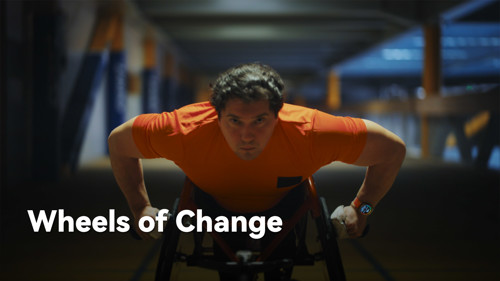
Wheelchair Mode, developed through collaboration with Health Labs worldwide, including in Helsinki, Finland, is emblematic of Huawei’s design approach. Throughout the presentation, it was striking to see how the brand emphasised real-world use cases, allowing their products to blend into the context in which they were displayed with confidence. The Huawei Watch GT 6, which has as its ambassador the marathon runner Eliud Kipchoge, was shown on the Olympian’s wrist as he ran with his team through the stunning Kenyan countryside. Its many features, such as precise positioning and intelligent marathon mode, reframe the smartwatch as a technologically cutting-edge tool for runners, both professional and amateur.

Over the last few years Huawei has launched a series of thoughtful, cleverly designed audio devices, with their clip-on earbuds, the FreeClip, being perhaps the most audacious in their design. This year the FreeBuds Pro 5 offer a more classical approach to the product, but now with the company’s dual-engine AI noise cancellation technology – another innovative application to practical problem solving.
The Huawei Mate 80 Pro brings all of the innovations for which the company is known to a product that looks as elegant as it is technologically groundbreaking. From an astonishing camera, with an eyewateringly powerful zoom, and upgraded True-to-Colour technology, to the advanced AI capabilities deployed by Huawei’s new OS, to the second-generation Kunlun Glass, the Mate 80 offers a combination of state-of-the-art engineering and expertise that is otherwise absent from the market. Here, as elsewhere, one has the sense that the device deploys technology to resolve emergent practical problems. This is innovation that cascades outwards from the palm of your hand toward your very interaction with the world.


The final device unveiled in Madrid was the brand’s first-ever mini tablet, the MatePad Mini. Feather-light and razor thin, the tablet sits at an elegant pocket size – large enough for reading, sketching and watching shows, but small enough for true portability. In the video that announced the MatePad Mini, a user strode across yet more astonishing landscapes, this time hiking with his tablet for company. Reclining on a rope bridge over a wild river, the MatePad Mini user lay down and took a video call.
It was a simple, but powerful image that spoke to how this tablet, like all of Huawei’s products, are conceived of as practical tools that facilitate your experience of life, and the world around you, in richer and more powerful ways. Rather than devices to take you out of the world, as a vector of escape into a stylised metaverse, these are tools to ground you and make your life IRL more viscerally exciting. As the presentation drew to a close, one was left with a strikingly optimistic vision of technological progress, rooted in powerful practical innovations.
Thomas Roueché
