
The MAX!
From a sewing school in Reggio Emilia to a museum floor in Shanghai – Max Mara opens its archive for its 75th anniversary.
There is a particular kind of rush that comes from standing in front of an open archive - not the hushed, glass-cased reverence of a conventional museum show, but something closer to the satisfaction of finding out what someone might deem worthy of saving, storing, and placing future historic value on. It's an effect the V&A East Storehouse has pioneered with real success, swapping academic remove for the sense that visitors are unboxing a collection in real time and discovering treasure. The Max!, Max Mara's 75th-anniversary exhibition at Shanghai's Long Museum, takes that lesson and runs with it – and the result, for a brand of this scale, is unexpectedly affecting.
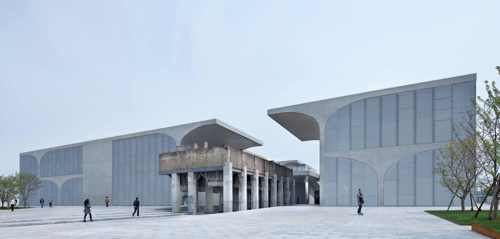
The choice of venue is not incidental. West Bund's Long Museum, with its raw concrete vaults and cavernous, hangar-like galleries, was designed by Atelier Deshaus to feel less like a conventional white-box institution than an excavated industrial relic - closer in spirit to the Tate Modern than a V&A in Kensington. It’s precisely this unfinished, structural quality that drew Olivier Saillard – who curated the exhibition along with associate curator Gaël Mamine – to the space. That austerity matters enormously to how The Max! reads: against bare concrete, the warmth of camel hair, the softness of a worn toile, the handwriting on a seventy-year-old order form, even the sewing machine of the brand’s founder all register with unusual intensity. The architecture refuses to compete with the archive, allowing the archive to speak louder.


The decision to entrust the show to Saillard was, on paper, an obvious one – he is fashion's foremost archaeologist of gesture, a curator who has spent his career insisting that clothes are never merely objects but evidence of labour, intention and lineage. What is less obvious, and more interesting, is what happens when his method meets Max Mara's particular history. His signature approach – refusing chronology and hierarchy; letting a 1981 coat sit beside a 2026 one as though decades were simply a trick of the light – in lesser hands could read as curatorial conceit. Here it reads as truth. As he puts it in the Q&A: “Max Mara owns a timeless body of work. Whether from the 1950s, the 1980s, or the 2010s, there is a relative consistency in forms, united by identical and noble materials. Therefore, it made more sense to highlight themes rather than dates. Max Mara transcends the short-lived nature of trends.”
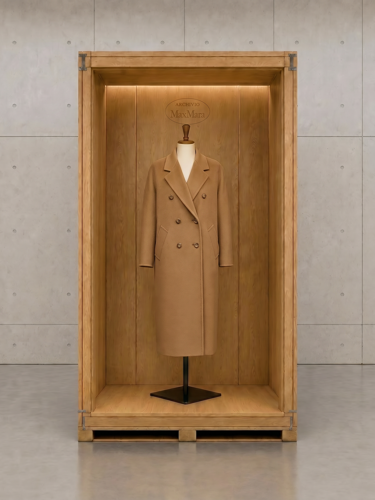
That sentence functions as the show's thesis statement. Walking through the show’s nine chapters – including the founding sewing school, the first factory, the vocabulary of style, the grammar of tailoring, the brand's enduring icons, a closing meditation on colour – you stop looking for a beginning and an end and start looking, instead, for repetition: the same red basting stitch, the same instinct for proportion. The scenography reinforces this beautifully. Crates – the utilitarian containers of most artwork transportation – become the show's organising motif, an honest admission that this is not a shrine but a working memory. Saillard has described wanting the space to feel like BAI, the company's own Biblioteca e Archivio d'Impresa in Reggio Emilia, brought to life rather than embalmed. He's succeeded. There's a pulse to the installation that is instilled as you walk through with no plan, no set direction and a huge desire to peer into all the nooks and crannies filled with souvenirs and working materials.
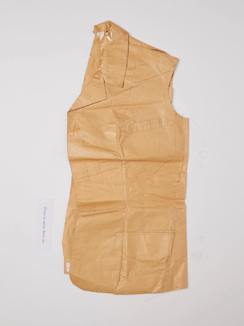
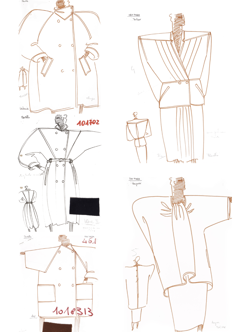
What struck me most, though, was how the show refuses to flatter the brand's own mythology in the way one might expect of a self-commissioned retrospective. It begins not with a coat or a campaign image, but with a sewing school – the one founded by Achille Maramotti's mother, Giulia Fontanesi Maramotti, to teach the art of tailoring to Italian women in the early twentieth century. Saillard has said this was his literal starting point: "The samples, the toiles, and the red basting threads served as the foundation for the entire exhibition." It is a curatorial choice with real consequence. By beginning with pedagogy rather than product, the exhibition quietly insists that Max Mara's real inheritance isn't a logo or a silhouette but more of a method – a set of hands-on values about teaching, humility and the transmission of craft from one generation of seamstresses to another. Achille Maramotti, a 24-year-old law graduate who chose an industrial sewing machine over a courtroom, becomes legible not as a slick entrepreneur but as someone who grew up quite literally inside a workshop.
This is where The Max! earns its emotional register. Fashion exhibitions so often default to spectacle, but here, the most affecting objects are the unglamorous ones: a worn pattern, a handwritten order form, the rulers and even the white atelier coat of the founder, fondly preserved. Saillard's admiration for the company's own internal rigour comes through clearly when he reflects on what surprised him most in his research: "I remain deeply admiring of how Max Mara and Laura Lusuardi established complete and essential archives very early on, anticipating by several decades an approach that is now widespread." It is a generous observation, but also a pointed one – a reminder that Max Mara was quietly building the infrastructure of its own memory long before "heritage" became a marketing department's favourite word.
